Washington to Shenandoah: plan a section of Skyline Drive, not a completion challenge
A road through a long park can tempt visitors to treat its full length as the default itinerary. For a short escape from Washington, choose a manageable section of Skyline Drive and a public entrance that serves it. The route should leave time to stop and pay attention, rather than turn the park into a driving-distance target.
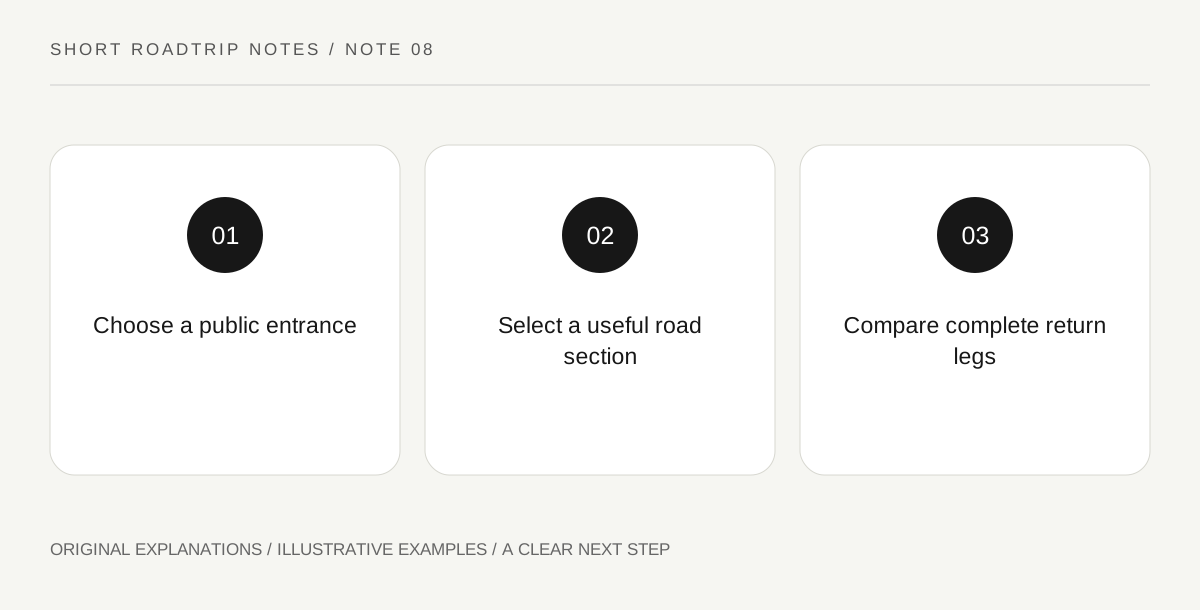
Original explanatory diagram. Read the full method and limitations below.
Begin with the public entrance
The official directions identify four entrance stations and explain that gated boundary service roads are not public entry routes. Save a named public entrance, then verify that it serves the section you intend to use. A nearby place outside the boundary is not evidence of a permitted drive into the park. This is particularly important when a navigation application draws an attractive line toward a trail or a mountain label without explaining the access arrangement.
Choose the section around your purpose
Skyline Drive spans the park, but a short visit need not span the road. Identify one or two types of experience the group actually wants, such as a developed viewpoint and a suitable interpreted stop. Locate them on the current park map, then choose the entrance and exit relationship. Do not use the full road length as a proxy for a satisfying day. A smaller section can support more time outside the car and fewer rushed decisions at each stop.
Give stops their own space
A road itinerary is not just the time a mapping tool predicts between endpoints. Pulling into a designated area, getting everyone ready, reading interpretation and returning to the vehicle all belong in the plan. Agree that the driver can decline an optional stop when safe access is not convenient. Passengers can keep a short list rather than calling for sudden turns. Only use permitted stopping places; the view is not a reason to create a roadside obstruction.
Decide whether to retrace or exit
Compare a return through the same entrance with a departure through another public entrance. The second option may add a substantial outside connection even when it appears to make progress along the park road. Sketch both complete journeys back to the Washington area before choosing. If conditions change, shorten the park section instead of defending a prewritten mileage ambition. The visit succeeds when its chosen experiences fit the people and the day, not when the car reaches an arbitrary endpoint.
An illustrative route decision
Imagine a Washington-area pair selecting one northern section and two developed stops. They save the proper public entrance, compare a retrace with a different exit and keep only the version that leaves a comfortable return. When the outdoor pause becomes the highlight, they remove an optional farther stop. All choices are illustrative; they do not assert current road opening, suitable weather or an exact driving duration.
Questions that come up
Is the full Skyline Drive necessary on a first visit?
No. Its length describes the road, not a minimum visit. Choose a section whose stops and return connection fit the time and access needs you actually have.
Can a boundary trailhead become an entrance for the car?
Not by assumption. Use official public-entrance directions. A hiking location or service road shown near the boundary does not establish general motor-vehicle access.
References and scope
These sources support the factual background. Examples and exercises are original illustrative teaching material. References do not imply endorsement.
- National Park Service — Shenandoah: directions — Four public entrances, Skyline Drive and the distinction from boundary service roads.