New York to Delaware Water Gap: build the short break on one riverbank
A narrow park can still create a surprisingly complicated driving day. Delaware Water Gap extends along two sides of a river, so attractive stops on the same screen may belong to different road corridors. For a short break from New York, choose a bank and a small cluster of places before adding a scenic circuit.
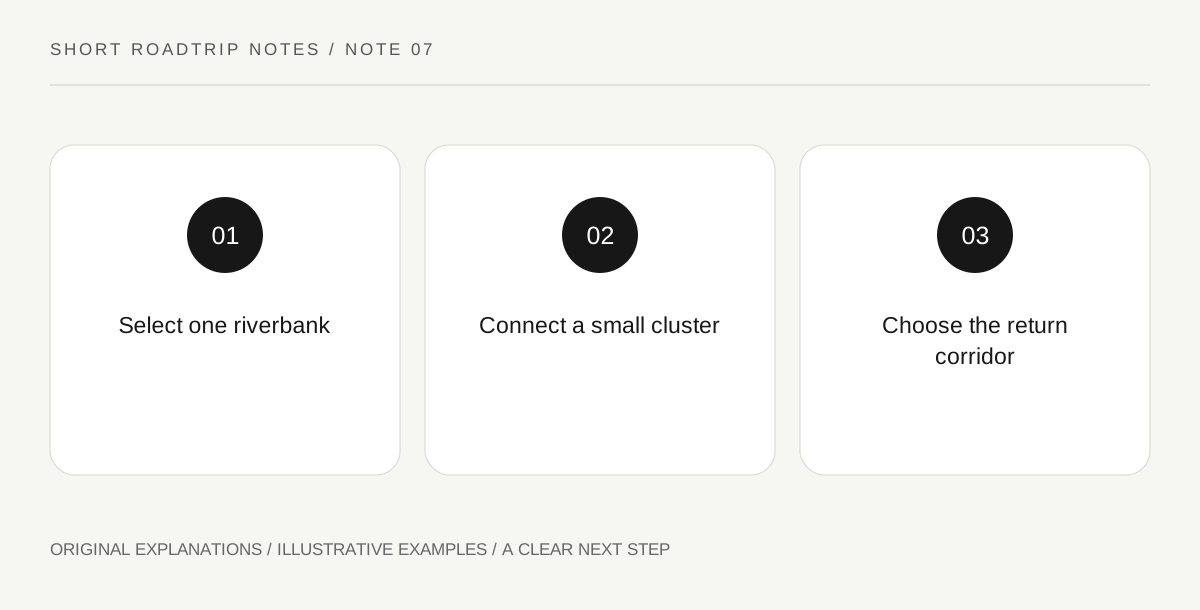
Original explanatory diagram. Read the full method and limitations below.
Read the park length before its highlights
Official directions describe a long park between the Interstate 80 and Interstate 84 corridors. That geography matters more than the order of photographs in a search result. Draw a simple north-south line and place your proposed arrival near the part of the park you actually want to visit. A southern destination and a northern destination are not interchangeable merely because the same park name appears on both. Begin with a small area rather than promising to traverse the full length.
Use the correct road corridor
The National Park Service identifies US209 as a main north-south route on the Pennsylvania side and Old Mine Road on the New Jersey side. These are separate planning corridors, not two labels for one continuous drive. Put a bridge crossing into the plan only when it serves a chosen destination and is available for your vehicle. Do not add it because a mapping application happens to create a visually pleasing circle between scattered saved points.
Choose a pair that shares a purpose
A useful short-break pair might combine one permitted outdoor activity with nearby interpretation or a quiet meal stop. Study the actual access for each before deciding they belong together. The aim is not to minimize all movement but to make each transfer worthwhile. If the second place repeats the first experience, consider staying longer at the first. If it offers something different, give the group enough time to understand that difference instead of rushing through both.
Make the last cross-river choice early
Before leaving the final main stop, choose the return corridor toward New York. A spontaneous extra crossing can introduce another road, another parking search and another set of decisions when the driver is already ready to leave. Put any genuinely optional detour before this decision point, not after it. Keep the plan adaptable to current closures and the day’s conditions. A satisfying short break can remain on one bank without needing to justify itself as a grand loop.
An illustrative route decision
For an illustrative overnight concept, two travelers choose a small New Jersey-side cluster and book a suitable base only after comparing the actual approaches. Their optional Pennsylvania-side idea stays on a separate list until they have checked the connecting route. They return toward New York from the bank they are already using rather than chasing a final photograph across the river. This is an example of route structure, not a recommended booking or real-time road report.
Questions that come up
Does staying on one bank mean missing the park?
It means selecting a coherent first visit. A park of this length supports many different outings; one short break does not need to represent every district or view.
Can an itinerary rely on a shuttle?
Only after checking the current operator’s actual service and how it connects with the parked car. A general mention of transport does not establish a usable connection for your date.
References and scope
These sources support the factual background. Examples and exercises are original illustrative teaching material. References do not imply endorsement.
- National Park Service — Delaware Water Gap: directions — Long park geography and separate Pennsylvania and New Jersey road corridors.