Boston to Minute Man: choose one historical unit before drawing a route
A linear historical park can look like a single destination on a phone while asking visitors to move between separate places. For a short drive from Boston to Minute Man, choose the part of the story you want first. Then build a small visit around that unit instead of trying to trace an entire historical landscape in one afternoon.
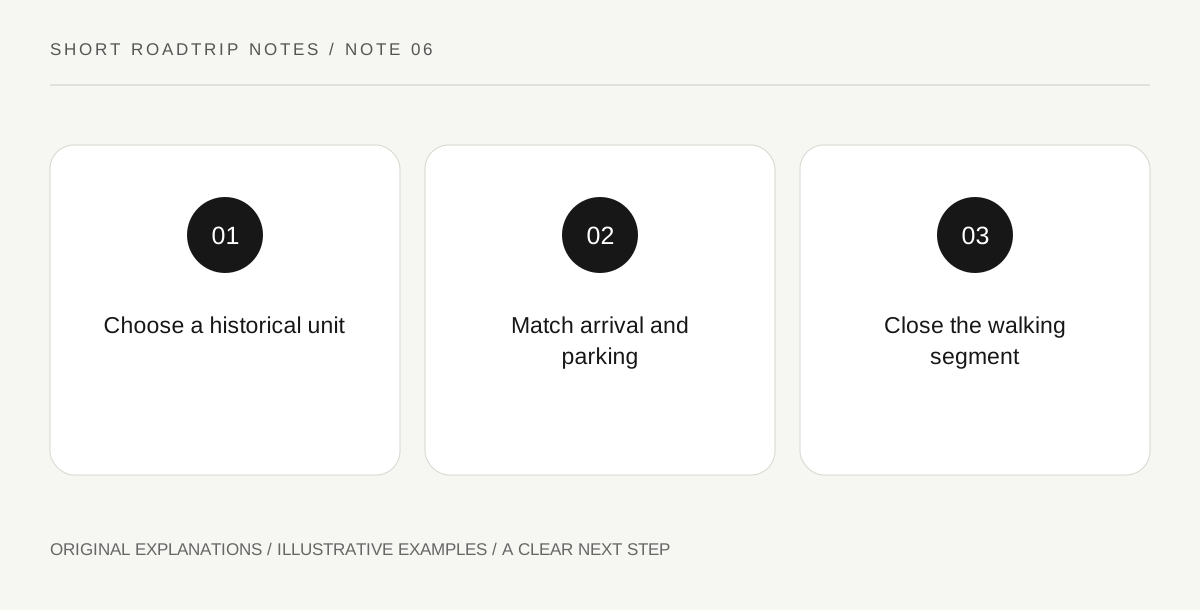
Original explanatory diagram. Read the full method and limitations below.
Choose the story before the car park
The National Park Service describes Minute Man as separate units across several towns. Its directions distinguish the Minute Man Visitor Center from the North Bridge area. Write the specific unit at the top of the plan and tell companions why it was selected. One person may be expecting an interpreted route while another imagines a bridge visit. Resolving that difference at home is more useful than finding the fastest driving route to a destination the group has not actually agreed upon.
Do not confuse two visitor-center destinations
Save the physical destination for the selected visitor center, then save the relevant parking location separately when the operator distinguishes them. A center, a historic feature and its car park can have different names. In the notebook, give each saved point a plain description of its role. This is particularly helpful for someone arriving later or collecting another traveler: the place where a visit begins is not necessarily the same place where a group will be waiting afterward.
Turn the first visit into a small chapter
Choose one interpretive question that suits the unit, such as how a mapped route relates to the ground you can see, or how an account explains a particular location. Read before trying to assign historical meaning to every visible detail. A short chapter with a clear question can be satisfying without claiming to represent the entire park. Keep an optional second unit genuinely optional, rather than quietly turning its absence into a failed itinerary.
Return the walker to the correct vehicle
Before walking away from the car, identify whether the proposed route returns to the same parking area. A linear landscape can encourage people to keep moving without noticing that the car remains behind them. Decide the turnaround or confirmed transfer while everyone is still together. The chosen walking segment should fit actual access needs and current conditions. A driving itinerary should never hide a substantial walking commitment behind the phrase next stop.
An illustrative route decision
Imagine a Boston group choosing the North Bridge unit for one focused visit. They save its actual arrival and parking points rather than the other visitor center, agree on a modest walking segment and leave the Battle Road area for a future day. The example illustrates a choice between units; it does not give operating hours, event access, admission conditions or a live journey duration.
Questions that come up
Can both main areas fit into a day?
Possibly, but build the transfer explicitly after giving each area enough attention. Two names in one park do not establish that the combined visit matches your group’s available time or walking needs.
Why avoid a broad park search?
It may resolve to a different unit from the one you intend. An exact physical destination keeps navigation, parking expectations and the historical purpose of the visit aligned.
References and scope
These sources support the factual background. Examples and exercises are original illustrative teaching material. References do not imply endorsement.
- National Park Service — Minute Man: directions and transportation — Separate park units and distinct visitor-center and North Bridge destinations.