Tucson to Saguaro: let one district be a complete short outing
Saguaro’s two districts sit on different sides of Tucson, which makes the park name an incomplete road-trip destination. A short outing works better when you choose one district, understand its arrival and give it enough attention. Crossing the city to collect the other district should be a deliberate second visit, not a hidden requirement.
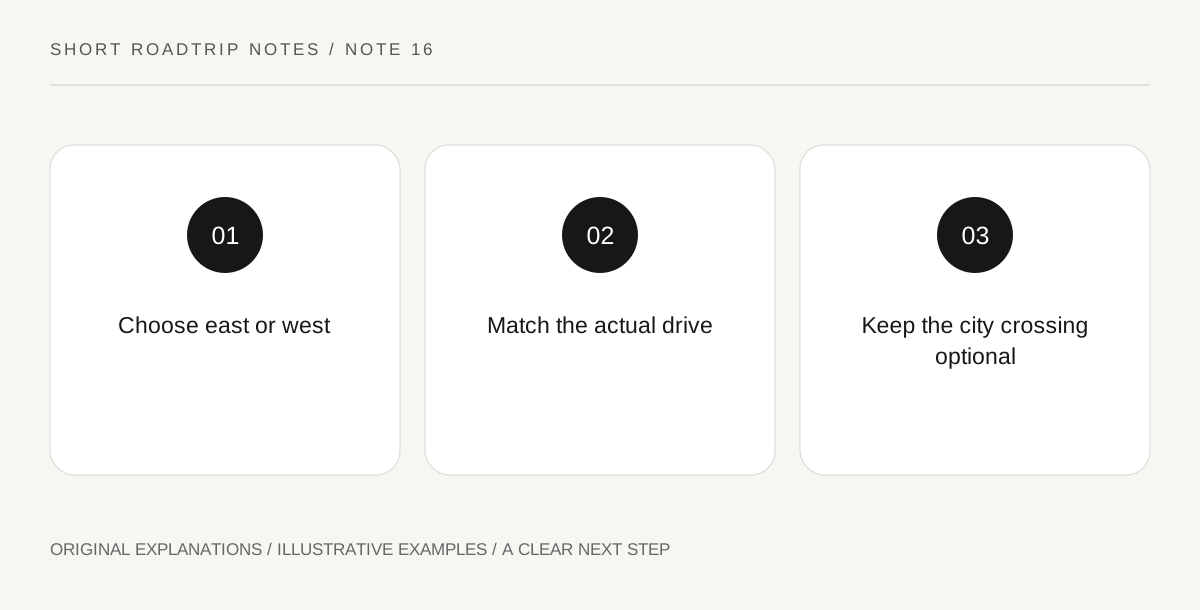
Original explanatory diagram. Read the full method and limitations below.
Choose east or west explicitly
Official directions distinguish the Rincon Mountain District in the east from the Tucson Mountain District in the west. They provide different physical addresses and caution against an ambiguous park search. Put the chosen district’s full name and actual destination in the shared itinerary. This is useful even for a local departure: a passenger can otherwise imagine one side of Tucson while the driver navigates toward the other. Start with the side that serves the experience you want, not an arbitrary map result.
Match the scenic drive to the district
The National Park Service identifies different scenic drives in the two districts, including Cactus Forest Drive in the east and Bajada Loop Drive in the west. Do not combine their names, road characteristics or restrictions into one imagined loop. Use current district-specific information to decide whether the intended drive suits the actual vehicle. A small passenger car, a wide vehicle and a vehicle towing a trailer can require different decisions. Resolve that before treating a scenic loop as the day’s centerpiece.
Make observation more than a moving view
Give the visit a specific, modest purpose, such as comparing the outlines and spacing of plants visible from an appropriate public place. Use current interpretation to identify what you are seeing rather than naming every cactus from a distant photograph. Plan only permitted stops and activities suitable for the conditions. An observational visit can remain meaningful without adding a demanding walk. Keep the road journey and any outdoor activity separate so the group can change one without losing the other.
Do not turn the city crossing into a reflex
Before proposing the other district, compare the complete drive across Tucson and the return to the original departure point. Ask what the second area would add beyond the experience already chosen. If the answer is simply that both names appear under one park, save it for another day. A district-specific first visit gives you a better basis for a future comparison. The outing can close after one good experience rather than after an exhausting attempt at territorial completeness.
An illustrative route decision
Imagine a Tucson group choosing the eastern district and saving its Old Spanish Trail destination. They compare the actual requirements for their vehicle before including the named scenic drive, then choose a permitted observation stop that suits the day. The western district remains a future outing, not a compulsory cross-city extension. These are illustrative decisions; they do not establish current road conditions, outdoor suitability or access for a particular vehicle.
Questions that come up
Can the same park pin serve either district?
It is safer to use the operator’s specific physical destination. The districts have separate arrivals, and a broad park search can send travelers toward the side they did not intend.
Does one district represent an incomplete visit?
No. A short outing is a selection. Give the chosen area a clear purpose and enough attention; use another day for a meaningful comparison instead of rushing both.
References and scope
These sources support the factual background. Examples and exercises are original illustrative teaching material. References do not imply endorsement.
- National Park Service — Saguaro: directions and transportation — Separate east and west districts and exact physical destinations.
- National Park Service — Getting around Saguaro — Different named scenic drives and vehicle-size constraints in the two districts.