Colorado Springs to Florissant: balance big tree stumps with small fossil evidence
A fossil outing can disappoint visitors who expect every ancient detail to stand beside a trail. For a short drive from Colorado Springs to Florissant Fossil Beds, pair the outdoor scale of petrified trees with the close attention of an exhibit visit. The different viewing conditions make the day more interesting, rather than competing for the same kind of spectacle.
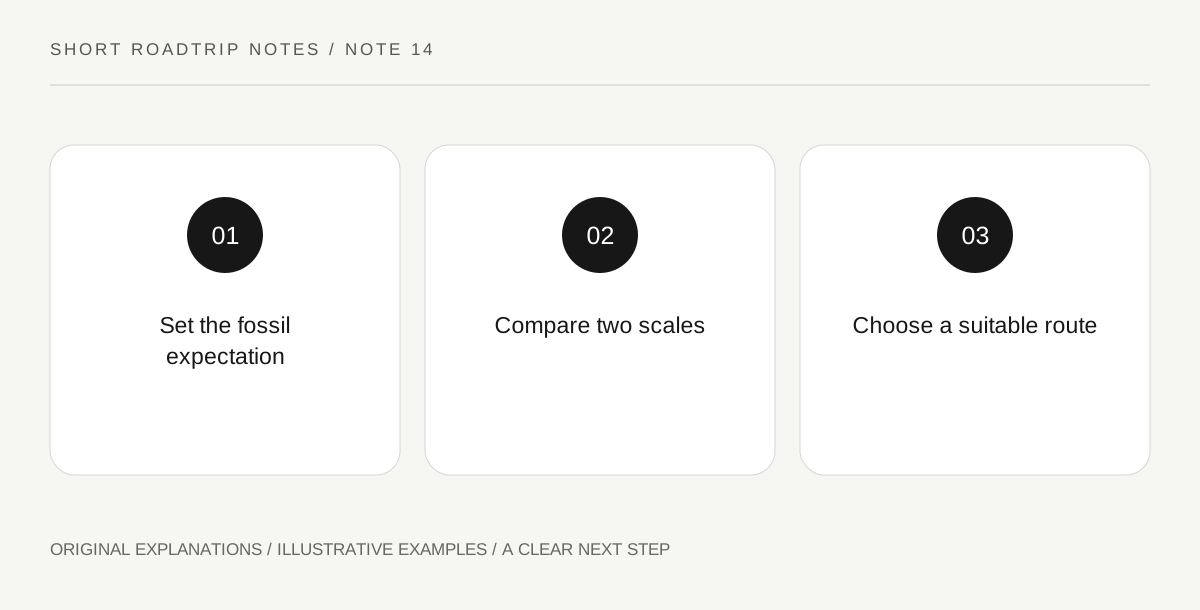
Original explanatory diagram. Read the full method and limitations below.
Choose the right expectation
Official basic information places Florissant west of Colorado Springs and distinguishes large petrified tree stumps from delicate fossil specimens best examined in visitor-center displays. Let that distinction shape the visit before departure. A small insect fossil and a large stump are evidence at different scales. If the group expects only dramatic objects outdoors, it may hurry past the interpretation needed to understand them. Tell companions that the outing involves looking closely as well as looking across a landscape.
Give exhibits a separate attention block
Choose one question for the indoor material, such as what a small preserved feature allows an interpreter to infer. Read the object information before trying to name everything from appearance alone. A short, careful comparison of two specimens can be more useful than rushing through a whole display. Give people permission to look at different things and exchange observations afterward. This keeps an educational stop from becoming a test in which one confident visitor supplies every answer.
Match an outdoor route to the group
The park describes short self-guided interpretive options as well as longer trails. Use the current route and accessibility information to choose what the group can comfortably do. A large mileage total is not the goal of a fossil visit. The outdoor portion should help connect the visible landscape and preserved features with the interpretation already encountered. Protected material is not a collecting opportunity: keep the activity to permitted observation, and leave specimens and ground undisturbed.
Leave room for a weather-led change
Do not make the educational value depend on completing a preselected walking circuit. If current conditions or individual needs make that circuit unsuitable, retain the exhibit question and use whatever appropriate public viewing is actually available. The drive back toward Colorado Springs can then close a coherent visit. Separating indoor and outdoor goals also helps you decide what to save for another day, instead of adding an unrelated roadside attraction to compensate for a changed walking plan.
An illustrative route decision
Imagine a Colorado Springs family agreeing to examine one small fossil feature in an exhibit and one large petrified-tree feature outdoors where permitted. They select an appropriate short route only after checking current information. When the outdoor part needs shortening, they keep the comparison between scales rather than rushing to another trail. This is an illustrative learning itinerary, not a current weather report or a promise that a specific path or display is accessible today.
Questions that come up
Are delicate fossils lying beside the paths for visitors to inspect?
Do not expect that. The park explains that much fossil evidence remains protected underground and that excavated delicate specimens are best seen in exhibits. Use the public interpretation rather than searching or digging.
Does a shorter walk weaken the visit?
No. A careful comparison between an exhibit and an outdoor feature can provide a clear learning purpose. Select walking for access and interest, not simply to make the road trip feel more demanding.
References and scope
These sources support the factual background. Examples and exercises are original illustrative teaching material. References do not imply endorsement.
- National Park Service — Florissant Fossil Beds: basic information — Colorado Springs proximity, protected fossils, exhibits and short interpretive options.