Austin to the LBJ sites: keep Johnson City and the ranch distinct
A short Hill Country history trip can contain two quite different arrivals. The Johnson City area and the LBJ Ranch near Stonewall share a park association, but they should not collapse into one address in a road itinerary. For an Austin departure, choose the historical purpose first and make any transfer between the areas deliberate.
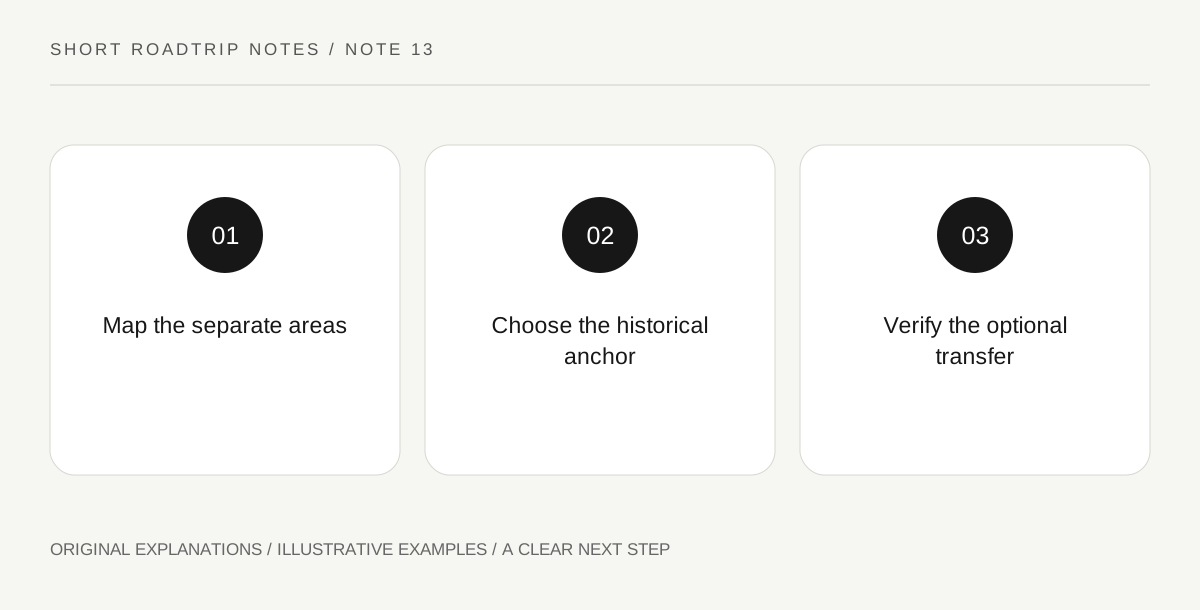
Original explanatory diagram. Read the full method and limitations below.
Sketch the two visitor areas
The official directions describe the Johnson City visitor area and the ranch area near Stonewall as separate places. Draw them as two boxes connected by a road leg. Put the actual chosen arrival in the first box, not just the park’s broad name. This simple sketch is useful when travelers are interested in different parts of the story: a childhood setting and a later working landscape should not be treated as interchangeable backdrops for the same quick stop.
Choose one area as the anchor
Decide which area provides the central experience for the day, then verify the access actually offered there. A short itinerary becomes more resilient when its meaning rests on one principal visit rather than on every component operating exactly as imagined. Give the group time to use interpretation and form questions. A photograph taken outside a building and an offered interior visit are different experiences; neither should be promised merely because the building appears on a map.
Treat the ranch procedure as a separate question
The transportation information distinguishes the state-managed visitor-center role near Stonewall from National Park Service ranch management. Use the current operator’s instructions to understand the arrival process for your chosen date. Do not assume an old description of a permit, a drive or an interior remains the complete present procedure. Record where any required orientation or permission is obtained before identifying the final destination. This keeps the transfer purposeful rather than turning a closed or changed access point into a frustrating surprise.
Keep the wider Hill Country optional
A nearby town, shopping idea or additional scenic drive can be enjoyable, but it should not crowd out the historical visit that justified the trip. Put these ideas after the main anchor and evaluate the whole return to Austin before accepting them. If the first area provides enough material for an absorbing day, leave the second for another outing. The plan is a selection of experiences, not an obligation to complete every place sharing a regional tourism label.
An illustrative route decision
For an illustrative Austin outing, a group chooses Johnson City as its main historical anchor. It keeps the Stonewall-area idea in a second box, with the actual transfer and current entry procedure still to be checked. When one visitor wants more time for interpretation, the group keeps the main visit and drops the extension. The example does not state that a ranch drive, particular interior or permit arrangement is available today.
Questions that come up
Should both areas always be included?
No. Their relationship can enrich a visit, but each requires its own access and time. Choose both only when the combined day serves the group’s interests without compressing the main experience.
Can an older permit description be copied into a new itinerary?
Use it only as a prompt for verification. The current operator determines the process, and a dated transportation page may not describe every present access change.
References and scope
These sources support the factual background. Examples and exercises are original illustrative teaching material. References do not imply endorsement.
- National Park Service — Lyndon B. Johnson: directions — Separate Johnson City and Stonewall visitor areas.