St. Louis to Ste. Genevieve: drive to town, then reduce the car’s role
A small historic-town trip rewards a different rhythm from a scenic highway outing. For a short drive from St. Louis to Ste. Genevieve, use the car to reach a clear arrival point, then organize the visit around a manageable set of public places. The useful question is how the stops relate, not how many houses can be counted.
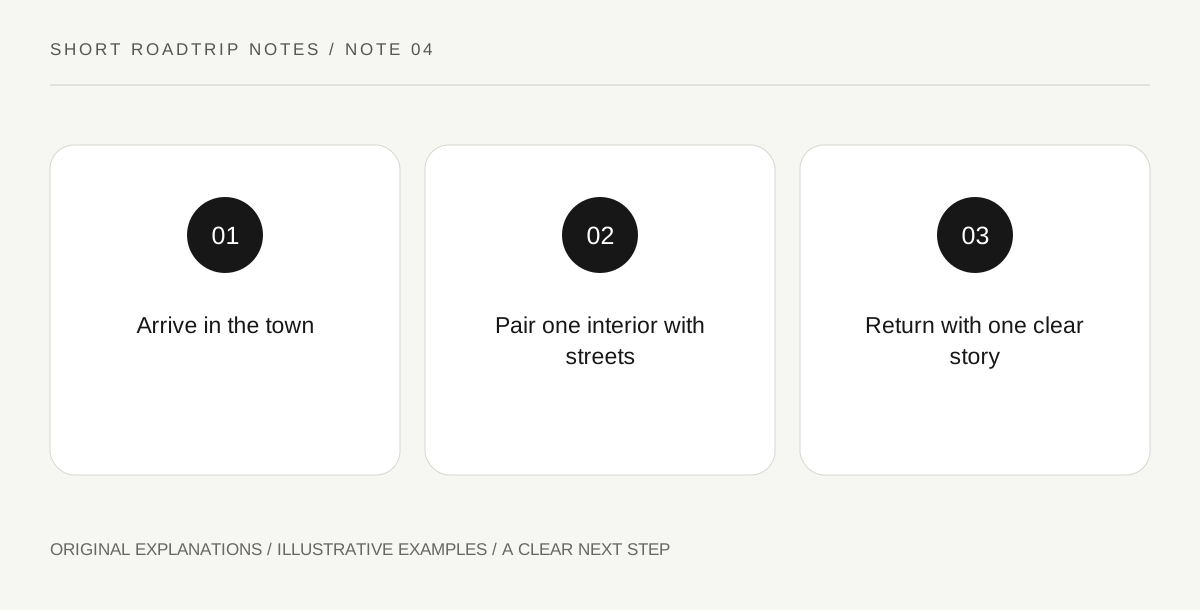
Original explanatory diagram. Read the full method and limitations below.
Begin with a town-scale map
Official directions connect the St. Louis approach with Ste. Genevieve and identify separate historic-house destinations. Use a current town map to draw a small cluster around the welcome-center area, rather than treating every named property as a drive-through attraction. Mark streets, crossings and the return to the vehicle. This first sketch exposes a route that looks compact in a list but asks the group to zigzag repeatedly or to cross a road more often than necessary.
Pair exterior reading with one interior
Choose one interior experience that is actually offered for your date, then allow time to look at the surrounding public streets and building relationships. An exterior observation and a guided interior answer different questions. The first can show how a property meets the street; the second can explain documented uses and people. Do not turn a closed doorway into permission to enter, and do not assume every historic property shares the same admission arrangement.
Match movement to the vehicle
The park’s directions distinguish ordinary approaches from an oversized-vehicle route to one property. That is a useful reminder to plan with the vehicle you will really bring. A comfortable passenger-car outing is not automatically a suitable motorhome itinerary. If a transfer is needed, identify designated parking first and let passengers know when the car will move. Avoid improvising a turn or waiting in a narrow access while the rest of the group searches for an entrance.
End with a question rather than another stop
Before returning to St. Louis, give everyone a moment to name one detail they understood better: a building form, a household story, or a relationship between the town and its wider setting. This gives the visit a conclusion without requiring another paid attraction. If the group wants food or browsing afterward, treat it as an unhurried separate choice. The town is a living place, so leave room for present-day activity as well as historical interpretation.
An illustrative route decision
In an illustrative day plan, two adults choose a welcome-center arrival, one available house visit and a compact public-street circuit. They do not assume they can enter a second house simply because it appears nearby. A companion bringing a larger vehicle prepares its parking and approach separately. The return to St. Louis stays flexible because the day has one principal visit rather than a chain of fixed appointments.
Questions that come up
Must the vehicle stay in one space all day?
No. Park-once is a planning preference, not a rule. Move it when a permitted transfer clearly improves access; make that movement explicit instead of repeatedly improvising.
Are historic houses interchangeable?
No. Their interpretation, ownership and available access can differ. Choose the story you want to understand and verify that the relevant property is receiving visitors.
References and scope
These sources support the factual background. Examples and exercises are original illustrative teaching material. References do not imply endorsement.
- National Park Service — Ste. Genevieve: directions — Town approach, historic-house locations and oversize-vehicle routing.