Louisville to Mammoth Cave: keep a short visit on the right side of the river
A cave trip can go wrong before anyone reaches a cave entrance: the driving destination may belong to the wrong part of a large park. For a short journey from Louisville, separate the visitor-service area, any booked tour and the park’s other districts before deciding how much the day can hold.
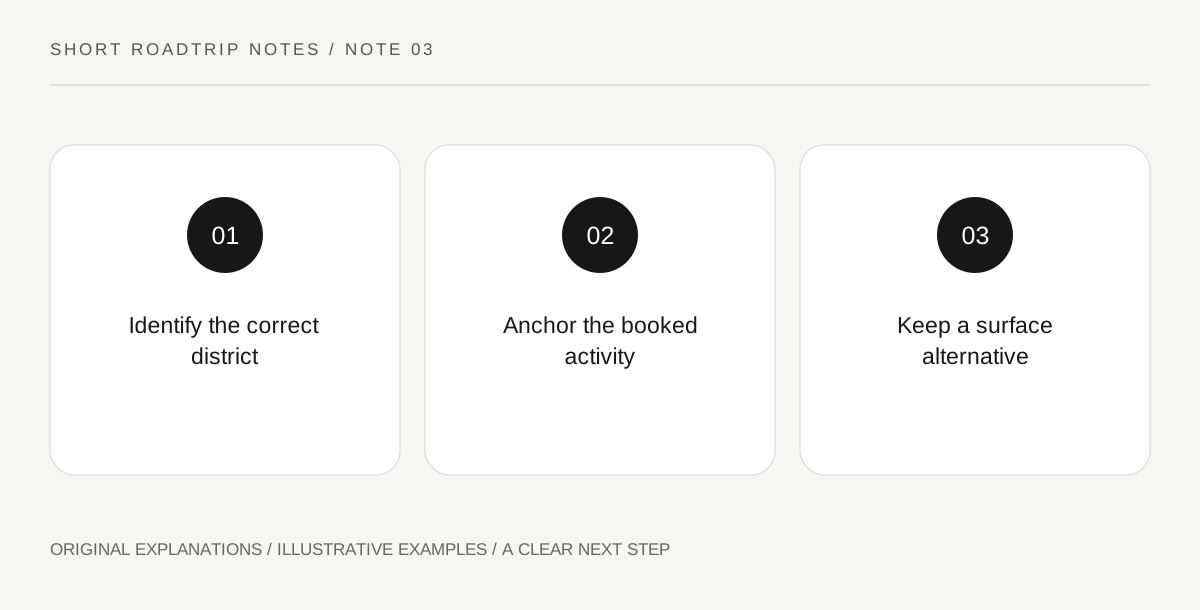
Original explanatory diagram. Read the full method and limitations below.
Read the river as a planning boundary
The National Park Service explains that the Green River divides Mammoth Cave National Park and that cave tours and most visitor services are on the south side. Put that fact at the top of the route note. A campsite, trailhead or map label elsewhere in the park may be real without being a useful arrival point for a tour. The first task is to match the exact destination to the activity, not to find the shortest line into the park boundary.
Build outward from the booked activity
If a cave tour is part of the visit, use the confirmed departure location and arrival instructions as the anchor. Then decide where to eat, pause and orient yourselves around it. Do not squeeze the tour between two loosely located outdoor stops. A reservation describes one specific experience, with its own access conditions and demands. It should not silently become evidence that every group member will find every cave route comfortable or that another tour is interchangeable.
Avoid the misleading shortcut
Official guidance warns that navigation systems can send visitors along an unsuitable approach. Compare the saved route with current park directions before departure. In particular, do not make a river crossing or a ferry connection an unexamined assumption in a tightly scheduled day. If you are considering another district, identify the actual road connection and decide whether the extra movement supports your purpose. A line across the map is not a guaranteed vehicle transfer.
Let the surface visit be complete too
A short trip can center on exhibits, an appropriate surface route and time to understand the setting, even if the preferred cave tour is unavailable or unsuitable. Decide this alternative before buying nonrefundable arrangements elsewhere. It is a different visit, not a counterfeit cave tour. Keep the group’s interest visible: people who came to learn about underground landscapes may value interpretation more than an unrelated last-minute attraction chosen only to fill the afternoon.
An illustrative route decision
Imagine a family traveling from Louisville with one confirmed tour. They save the south-side visitor-center destination, put the tour’s actual check-in instructions in the itinerary and leave a separate north-side trail for another trip. Their alternative day uses available interpretation and a suitable surface activity if the tour cannot happen. The example illustrates sequencing; it does not promise ticket availability, ferry operation or a particular travel time.
Questions that come up
Can a general park address replace tour instructions?
No. Use the operator’s instructions for the specific booked activity. A park covers many destinations, and the correct entrance for one purpose may not suit another.
Should a ferry be included just to make a loop?
Only if it serves a real purpose and current operation fits a flexible plan. Do not make a potentially variable crossing the hidden dependency before a fixed departure time.
References and scope
These sources support the factual background. Examples and exercises are original illustrative teaching material. References do not imply endorsement.
- National Park Service — Mammoth Cave: directions and transportation — South-side visitor services, the Green River division and navigation limitations.