Cleveland to Cuyahoga Valley: organize the visit along one valley spine
Cuyahoga Valley sits close enough to Cleveland to tempt a long list of quick stops. A better short outing uses one arrival anchor and a geographically coherent stretch of the valley. The point is to spend time in a place, rather than repeatedly finding the car and restarting the navigation.
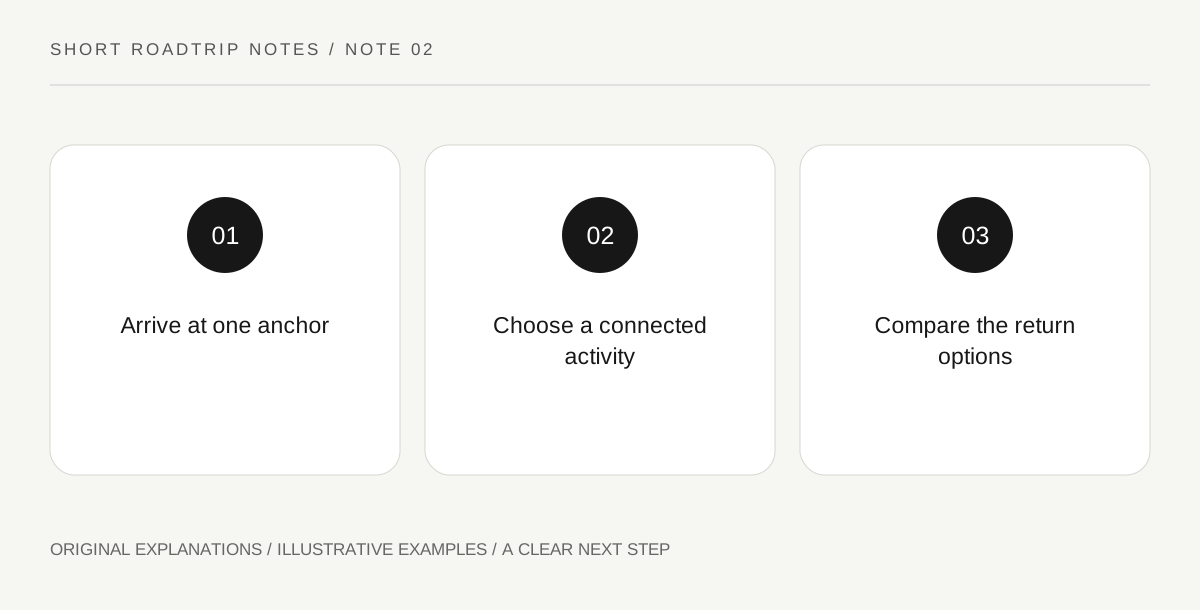
Original explanatory diagram. Read the full method and limitations below.
Anchor the plan at Boston Mill
The official directions identify Boston Mill Visitor Center on Riverview Road in Peninsula. Save its specific destination instead of using a general park search. On a simple sketch, mark where you will approach from Cleveland and where the selected outdoor stop lies relative to the center. This turns a sprawling mental picture into a small relationship between two places. It also helps you spot an itinerary that repeatedly crosses its own route for no clear benefit.
Pair an introduction with one activity
Use orientation to choose an open activity that matches the group: a modest walk, a particular interpreted place, or time beside a landscape feature shown on the current park map. Ask what the group wants to learn or experience before comparing options. Someone seeking a quiet walk and someone collecting photographs may agree on one location if they can describe their purpose. Do not assume a short driving leg means an equally short or suitable walking route.
Distinguish travel time from stop time
The park’s published driving estimates describe reaching the area; they do not account for your own parking, unpacking, walking and conversations. Give the visit its own time block before deciding when to return. In the notebook, separate the outbound drive, the chosen activity and the return drive. This makes changes easier to negotiate. If a meal takes longer, the group can shorten an optional stop without having to reinterpret every number in the plan.
Return without inventing a grand circuit
An out-and-back journey can be a deliberate design. A loop is useful only when its extra road serves a real second purpose. Before leaving the last stop, compare the direct return with any proposed scenic detour and ask what that detour adds for the people actually in the car. Keep a place for a comfortable pause before entering busier roads. The closing part of the day should respect driver attention rather than demand one more attraction.
An illustrative route decision
For an illustrative half-day concept, a Cleveland group records Boston Mill as its orientation point and selects one nearby activity after checking the official map. They budget their own walking and meal time separately from driving. When a passenger proposes an additional cross-valley stop, they save it for another visit because its purpose duplicates the first. No departure hour or travel duration here is a live traffic estimate.
Questions that come up
Is a loop always more efficient?
No. A loop may add distance, parking and decisions. Compare the full chain of stops; returning along a familiar corridor can be the calmer choice for a short visit.
Can the same concept start in Akron?
Yes, with a different approach. Rebuild the small map from your actual departure point rather than copying the Cleveland leg or assuming the same first stop remains convenient.
References and scope
These sources support the factual background. Examples and exercises are original illustrative teaching material. References do not imply endorsement.
- National Park Service — Cuyahoga Valley: directions — Boston Mill Visitor Center, Cleveland and Akron approaches and location-specific addresses.