San Francisco to Point Reyes: make Bear Valley the first destination, not the whole park
Point Reyes is close enough to San Francisco to appear as a casual day-trip suggestion, yet reaching its orientation area and reaching a distant headland are different journeys. Give a short outing one clear arrival at Bear Valley, then choose a limited next step from the park’s actual destination information.
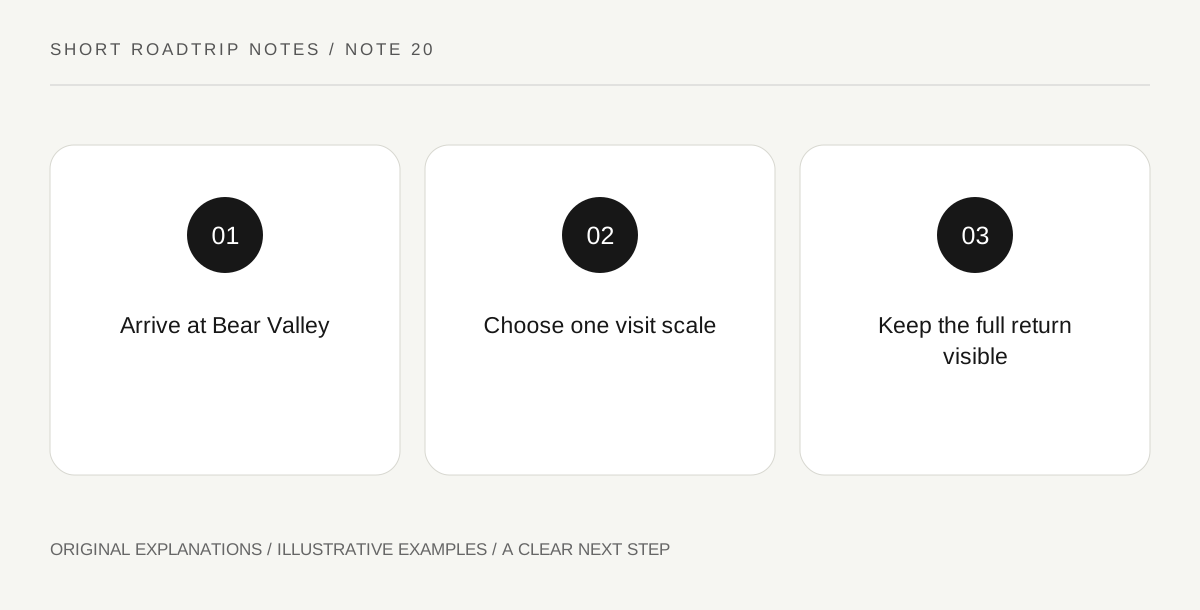
Original explanatory diagram. Read the full method and limitations below.
Separate the approach from the internal drive
Official directions provide approaches to Bear Valley Visitor Center and link separately to directions for other park destinations. Preserve that distinction in your itinerary. The San Francisco approach can involve crossing the Golden Gate Bridge and continuing toward the Olema and Bear Valley area, but that does not place the car at every place associated with the seashore. Save the orientation destination first and enter any later destination as its own journey leg rather than extending an undifferentiated park pin.
Choose the visit scale at orientation
Decide whether the main experience is a modest activity near the arrival area or a deliberately selected farther destination. Use current information about that actual place before committing the group. A dramatic headland photograph can distort the perceived scale of the day: it does not show the entire road approach, parking process, access requirements or return. A smaller visit can still provide a clear encounter with the landscape and interpretation, especially when it gives people time to stop rushing.
Use parking for its intended visit
The operator distinguishes parking choices around Bear Valley, including guidance for visitors staying longer in that area. Read the current signs and information rather than assuming the most convenient-looking paved space is the right place for every length of visit. Give the group a clear reunion point before people separate. If the car will move to a later destination, say so explicitly; a companion should not return from a walk expecting the vehicle to remain where it arrived.
Keep the return in the drawing
The winding approach is part of the road-trip design, not empty space between attractions. Compare the full journey back to San Francisco before adding another distant destination. A short coastal outing need not continue until the last possible daylight moment. If the main visit takes longer, remove the extension instead of compressing every remaining leg. The goal is a complete, attentive day with an understandable return, rather than proof that the car reached every geographically scattered point carrying the Point Reyes name.
An illustrative route decision
Imagine a San Francisco pair saving Bear Valley as its first destination and choosing a suitable modest visit there. A farther headland idea has its own road leg and current access questions written beneath it. When the first visit fills the available time, the pair leaves that extension for another day and follows the planned return. These are illustrative decisions, not live navigation, a parking promise or an assertion about access to a particular coastal feature.
Questions that come up
Does reaching Bear Valley mean the lighthouse or headlands are nearby?
Do not assume that. The park provides separate destination directions because the internal journey matters. Enter the actual next place and assess its current access and full return connection.
Can a visit near the orientation area be the whole day trip?
Yes, when its available activities fit the group’s purpose and needs. A short outing does not require reaching the farthest photographable feature to count as a worthwhile visit.
References and scope
These sources support the factual background. Examples and exercises are original illustrative teaching material. References do not imply endorsement.
- National Park Service — Point Reyes: directions and transportation — Bear Valley arrival, separate destination directions and winding approaches.