Portland to Fort Vancouver: keep the nearby historic units on the correct map
A short drive across a state line can still contain an easy geographical mistake. Fort Vancouver’s main visitor facilities are in Vancouver, Washington, while another associated house is in Oregon City. For a Portland-area outing, choose the main cluster or the separate unit deliberately instead of letting a shared historic-site name blur the route.
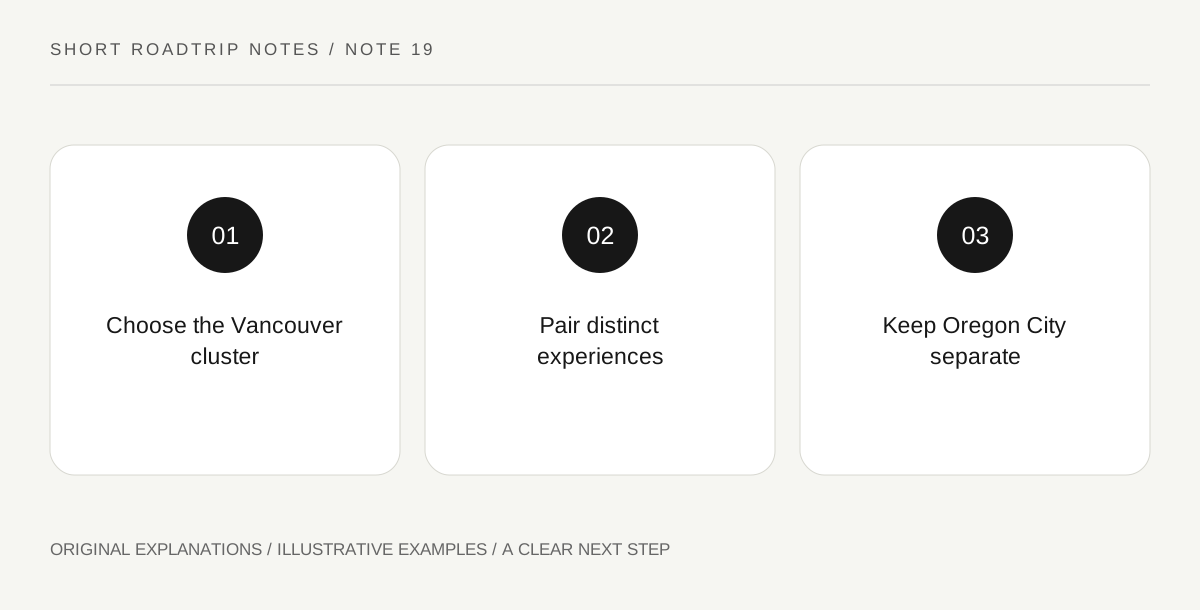
Original explanatory diagram. Read the full method and limitations below.
Start with the Vancouver cluster
Official directions place the visitor center, reconstructed fort, barracks landscape and Pearson Air Museum in Vancouver on the north side of the Columbia River. Choose the actual arrival destination for your intended first experience. A headquarters address, a visitor-center address and a museum car park can serve different roles even within one cluster. Put those roles in plain language in the shared plan so companions know where to meet and which place the driver is actually approaching.
Choose two different kinds of attention
A compact visit might pair one offered interior or interpreted experience with time reading the surrounding public landscape. The reconstructed fort and an aviation-focused museum should not be treated as interchangeable items on an attraction list. Ask what each contributes to the group’s interests before deciding on a pair. A visitor who wants to linger over one subject should not have to rush merely because another nearby institution appears under the same park association.
Keep Oregon City separate
The National Park Service identifies the McLoughlin House unit in Oregon City as a separate destination, with a substantial road transfer from the Vancouver facilities. Put it in a second box on the map, not on the same walking circuit. It may make an excellent different outing or a deliberate extension, but its association with the same historic site does not make the transfer disappear. Compare its current access and the complete journey back to the Portland-area departure before combining the visits.
Make the final parking move purposeful
Within the chosen cluster, use designated parking and the operator’s current connections between facilities. Decide whether to walk or move the car according to actual access needs and conditions. A short physical separation is not a reason to improvise stopping on an access road or assume every connecting path suits everyone. End the visit after its chosen pair unless another experience adds a clear new purpose. The state-line drive can then remain a modest part of the day rather than grow into a regional collection exercise.
An illustrative route decision
An illustrative Portland group chooses the Vancouver visitor-center cluster and investigates one fort experience plus the aviation subject at Pearson. It saves the relevant destinations separately and compares the permitted movement between them. McLoughlin House stays on a future Oregon City outing instead of being described as another room nearby. The example does not promise opening hours, tours, current parking or a particular drive duration across the river.
Questions that come up
Is Fort Vancouver in British Columbia?
This itinerary concerns the National Park Service site in Vancouver, Washington. Use the exact state and destination when planning from Portland so a familiar city name does not introduce an entirely different journey.
Can McLoughlin House be walked to from the main fort cluster?
Do not plan it as part of that walking cluster. The official transportation information identifies a separate Oregon City unit and a road-distance separation; build its transfer explicitly if combining the visits.
References and scope
These sources support the factual background. Examples and exercises are original illustrative teaching material. References do not imply endorsement.
- National Park Service — Fort Vancouver: directions and transportation — Vancouver facilities and the separate McLoughlin House in Oregon City.