Miami to Biscayne: separate the drive from the on-water visit
A road trip to Biscayne needs an unusual distinction: reaching the park by car is not the same as arranging the wider water-based experience shown in many photographs. Start a short Miami-area outing with a clear mainland arrival, then decide whether a separate, properly arranged water activity belongs in the same day.
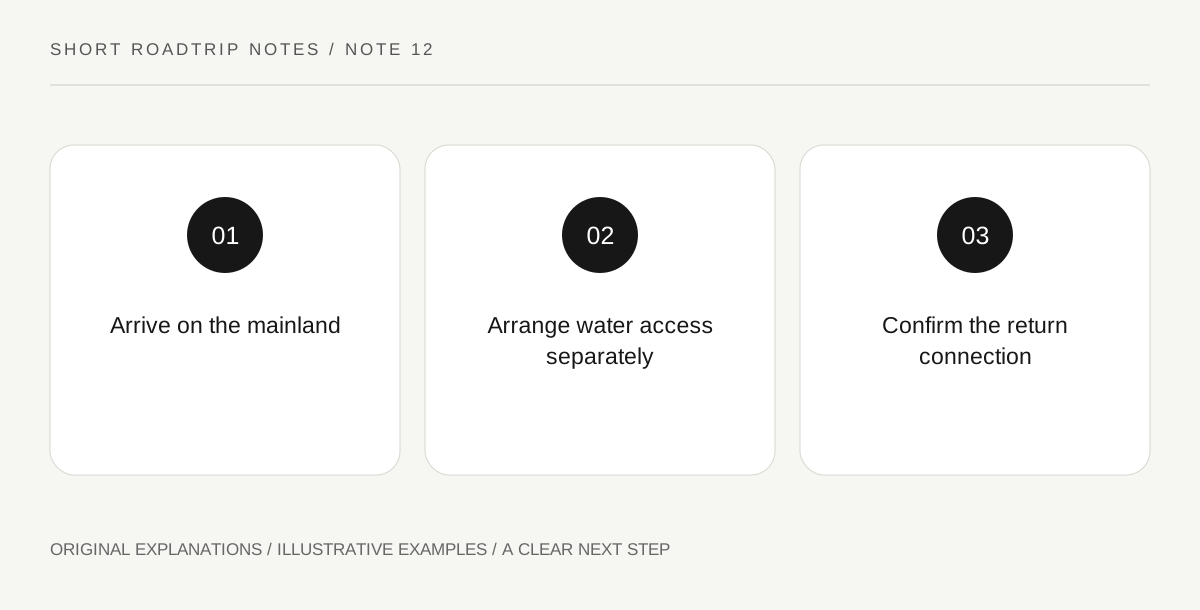
Original explanatory diagram. Read the full method and limitations below.
Pin the mainland arrival
The official directions route drivers to the Dante Fascell Visitor Center in Homestead. Save that specific arrival rather than an island label or a general image-search location. This gives the group a real place to begin and a clear answer to the question of where the vehicle will be. If you have arranged an activity, compare its actual departure location with this arrival point instead of assuming every operator begins at the visitor center.
Recognize the change in transport
The National Park Service describes Biscayne as predominantly covered by water. That geography explains why a car itinerary alone cannot stand in for the full range of park experiences. Make any on-water component its own decision, with a specific provider or authorized arrangement, current conditions and participant requirements. A photograph of an island does not promise a land connection, a boat seat or a suitable outing for every traveler. The transfer needs as much clarity as the drive.
Build a complete mainland alternative
A day should not collapse if the selected water component cannot happen. Choose what you would value in a mainland orientation visit and decide whether that alone justifies the journey for your group. Keep this alternative honest: it is not a substitute claim that every reef or island experience is visible from the arrival area. It is a different visit, centered on understanding the setting and using the public experiences actually available on the mainland that day.
Protect the connection back to the vehicle
When an activity leaves the mainland, identify where it returns and how that connects to the parked car. Do not infer a return time from the outbound departure or from the duration of a different product. Put the operator’s current instructions in the plan and leave the subsequent drive flexible. The driver should have room to assess the return journey after the activity, rather than face another fixed appointment that depends on every earlier movement occurring without delay.
An illustrative route decision
Imagine a Miami-area pair saving Dante Fascell as their mainland arrival while separately investigating a permitted boat experience. They compare its actual meeting location and return arrangements before booking. They also decide whether an available mainland visit would be worthwhile if the water activity cannot operate. Their plan does not turn an island photograph into a driving destination. These are illustrative planning choices, not a recommendation of an operator or a promise of conditions.
Questions that come up
Does arriving at the visitor center include a boat trip?
No such inclusion should be assumed. Treat any activity as its own arrangement and verify its current terms, departure point, participant requirements and availability with the operator.
Can the drive and boat portion share one time estimate?
That hides important transitions. Record the drive, arrival preparation, activity and return separately so the group can see which parts are flexible and which depend on a confirmed arrangement.
References and scope
These sources support the factual background. Examples and exercises are original illustrative teaching material. References do not imply endorsement.
- National Park Service — Biscayne: directions — Mainland Dante Fascell Visitor Center approach in Homestead.
- National Park Service — Biscayne visit planning — Predominantly water-based park geography; separate mainland arrival from an on-water experience.