Columbia to Congaree: make the vehicle a day-use tool
Congaree can suit a short outing from the Columbia area, but the arrival plan deserves more precision than entering a broad park name. Use the visitor-center approach as a clear anchor, choose an appropriate current activity and keep the car’s role within the park’s actual rules. A short distance does not make parking or overnight assumptions disappear.
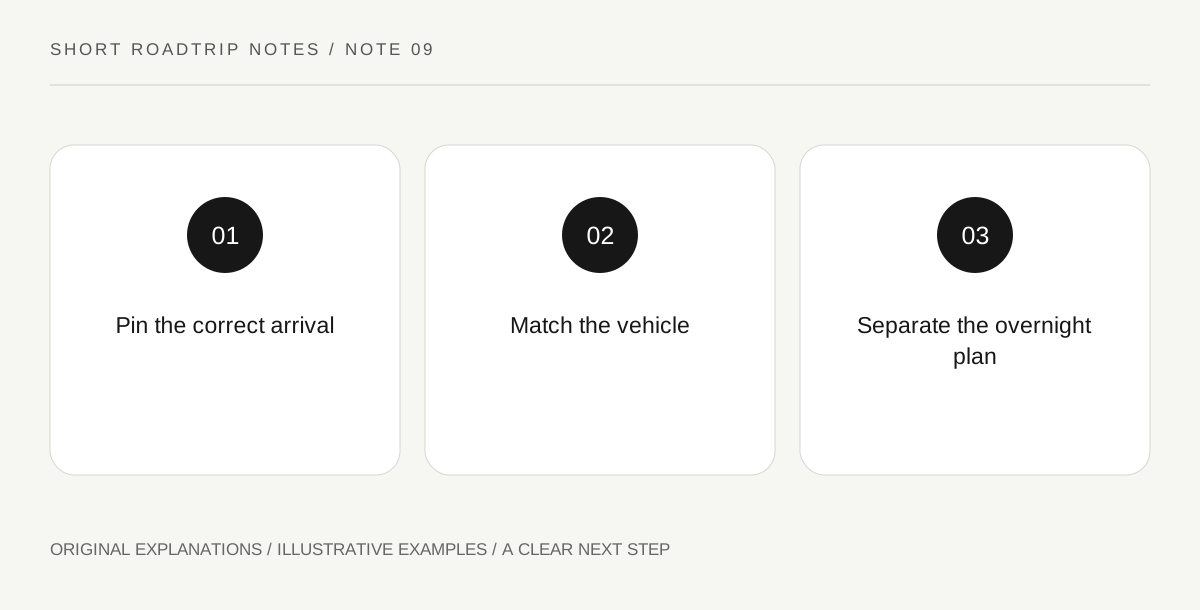
Original explanatory diagram. Read the full method and limitations below.
Save the Harry Hampton arrival
The park’s directions give a specific National Park Road address for reaching the Harry Hampton Visitor Center area and warn that a general park search can misdirect visitors. Save that destination before choosing later activities. Share it with everyone in separate vehicles. On arrival, use current information to select an open, suitable visit rather than expecting a saved route to describe conditions on the ground. The first destination is an orientation tool, not a guarantee about every path beyond it.
Plan with the actual vehicle
Official information identifies limited oversized-vehicle parking and access limitations at other trail parking areas. Measure the plan against what you are bringing: a passenger car, a motorhome or a vehicle towing another vehicle. A general photograph of a parking lot cannot answer whether that combination can enter and turn around comfortably. If the proposed outing depends on a smaller parking area elsewhere, resolve its suitability before leaving the main arrival point rather than hoping to discover space at the end.
Keep day use separate from sleeping
The National Park Service explicitly prohibits sleeping overnight in vehicles anywhere in Congaree, including its frontcountry campgrounds. Do not convert a delayed return into an improvised car-camping plan. If the wider trip needs an overnight, arrange a lawful option outside this assumption and check its actual conditions. Separating the day visit from accommodation gives the group clearer choices: extend the visit within available access, return to Columbia, or use the overnight arrangement already chosen for the broader journey.
Choose the activity after the arrival picture is clear
A short outing can have a modest purpose: learn about the landscape, follow an appropriate open route or spend time observing from permitted places. Ask which option matches the current conditions and the group’s abilities. Do not promise a fixed outdoor sequence merely because the drive from the city seems manageable. Give the return to the vehicle a clear place in the plan, and leave enough flexibility to shorten the activity without inventing a prohibited overnight solution.
An illustrative route decision
An illustrative Columbia group arrives in one passenger car and selects a suitable short activity after orientation. A friend considering a motorhome checks its parking arrangements separately rather than copying the same arrival note. The group has a return plan for the day and does not treat an empty vehicle space as an overnight campsite. The example illustrates decisions, not current parking availability or trail conditions.
Questions that come up
Can a campervan stay overnight because it fits a parking space?
No. Physical fit does not replace the park’s prohibition on sleeping in vehicles. Arrange accommodation through an option whose operator actually permits the intended overnight use.
Is every trailhead a suitable alternative when the main lot is busy?
No. Different lots have different access and vehicle constraints. Choose another destination only after checking its suitability and current conditions, rather than using it as an unexamined overflow area.
References and scope
These sources support the factual background. Examples and exercises are original illustrative teaching material. References do not imply endorsement.
- National Park Service — Congaree: directions — Harry Hampton arrival, vehicle parking limits and prohibition on sleeping in vehicles.